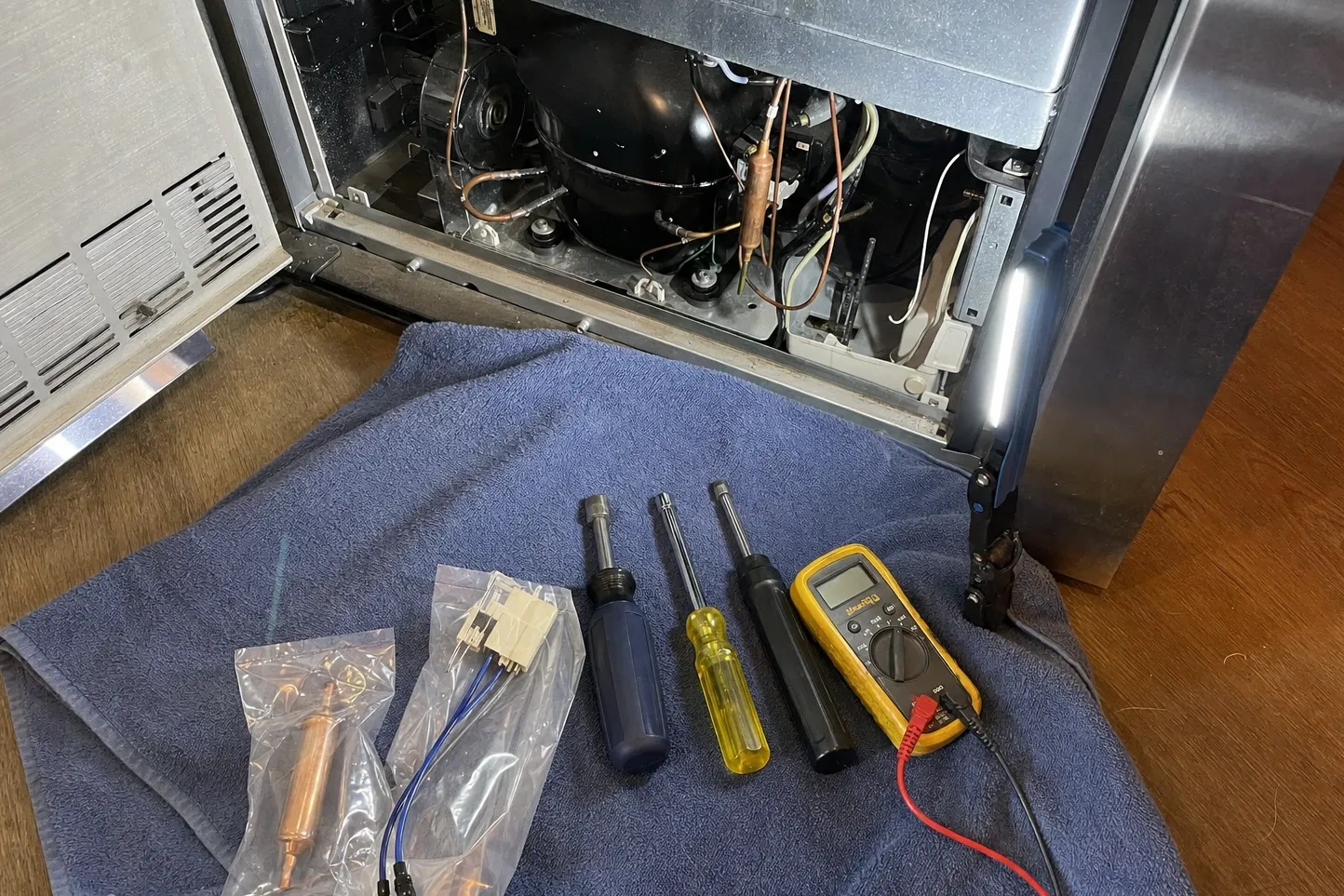
Refrigerator Repair
Sub-Zero Refrigerator Life Expectancy, Read From the Serial Tag
Written by
Yuki Tanabe
Refrigeration technician — controls and sensors · 18 years in the trade
Tests a sensor against an independent reading rather than trusting the display it feeds. Drift is quiet, cheap to correct, and routinely mistaken for a dying compressor.
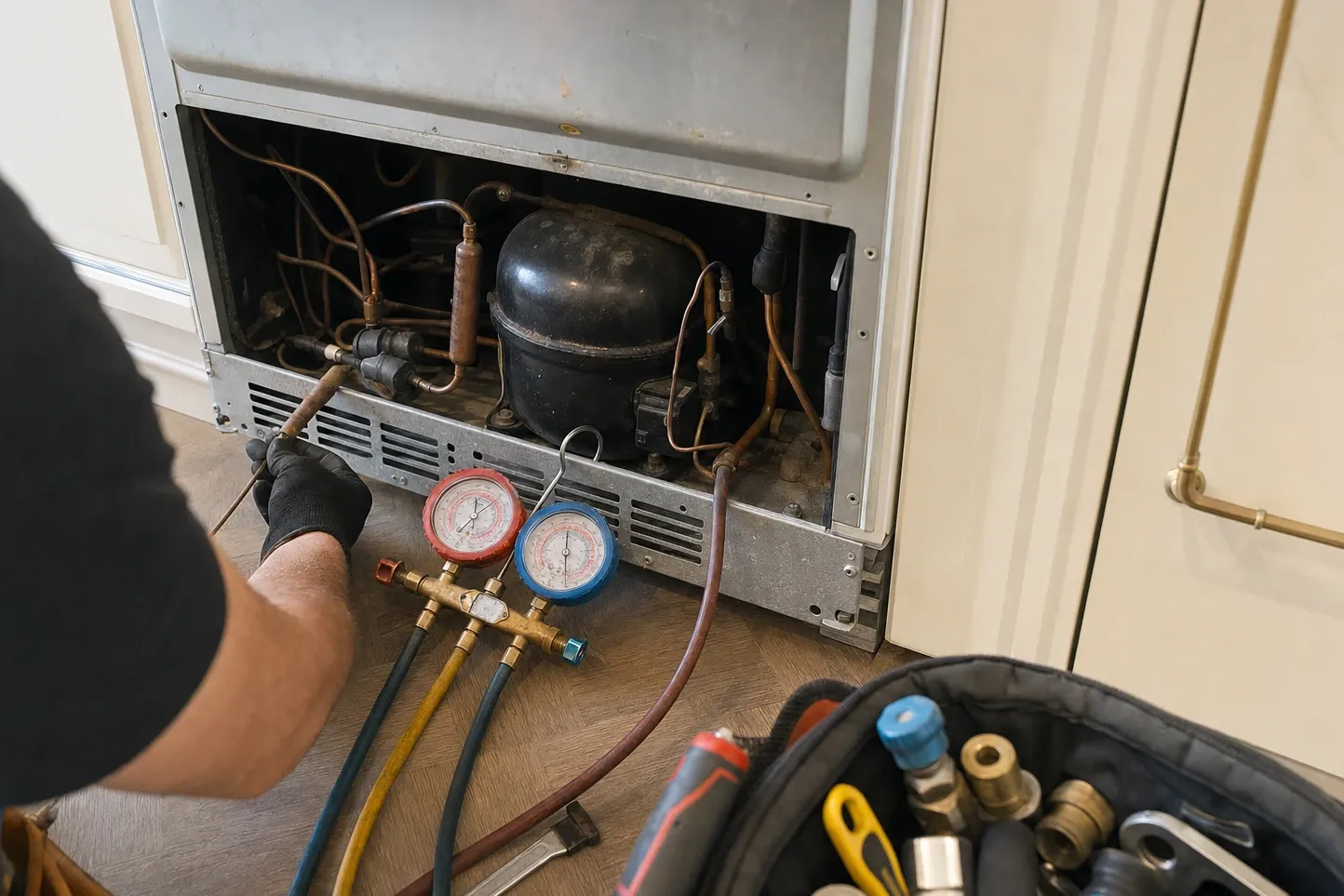
Plan on roughly 20 years from a Sub-Zero built-in refrigerator, and treat 25 or more as realistic for one whose condenser has been kept clean and whose worn parts were replaced as they went. That life comes from the design rather than luck: the compressor, fans, control boards and door gaskets can all be serviced, so the cabinet can outlast any one of them. The first step in judging your own unit is to find its birth year, which is printed on the serial tag, not guessed from the look of the door panels.
Why these refrigerators outlive ordinary ones
An ordinary freestanding refrigerator tends to be retired when its first expensive part fails, because the repair costs close to what a new one does. A built-in Sub-Zero sits on the other side of that sum. It is fitted into cabinetry, often panelled to match it, and replacing it means a new unit plus the carpentry to make it fit. That gap is why owners in Bel-Air and Brentwood keep these refrigerators going through repairs that would end the life of a cheaper machine.
The other reason is access. The condenser sits behind a grille at the top or a kickplate at the bottom rather than buried against the wall, the fans and defrost parts can be reached, and the refrigerant circuit can be opened, repaired and recharged. Life expectancy on these units is really a question of how many repairs you are willing to fund, and how long parts stay available for your series.
Date yours before deciding anything
Every Sub-Zero carries its build date on a serial tag, and where you hunt for it depends on the layout. With the freezer below the fresh-food section, open the refrigerator door and check the top corner by the hinge. A side-by-side keeps its tag on the freezer side, and a Classic French-door puts it on the left door. On a Designer Column (IC or DEC), open the middle drawer and look near the drawer guide on the side away from the hinge.
The series name narrows the age further. Sub-Zero’s own model timelines give these production windows:
| Series | Built |
|---|---|
| 500 Series | 1987 to 2003 |
| 700 Series | from 1994 (the 700BR was among the first); most now discontinued |
| 600 Series | 1996 to 2009 |
| 648PRO (PRO 48) | 2005 to 2019 |
| Classic BI | 2008 to 2022 |
| Designer IT and IC | 2014 to 2022 |
| PRO3650 and PRO4850 | 2019 to today |
| Classic CL, Designer DET and DEC | 2022 to today |
The names also changed in March 2019: what had been sold as Built-In became Classic, and Integrated became Designer, so an older manual may use the earlier label for the same family. Any 600 Series unit still running today is at least 17 years old, and a 500 Series one is past 23.
What shortens the run in Los Angeles homes
Heat and dust do the slow damage. Every bit of warmth removed from the cabinet has to leave through the condenser, and a mat of lint and pet hair across its fins makes the compressor run longer every hour of every day. Sub-Zero’s interval is six to twelve months, shortened in homes where a dog or cat sheds. Long summer heat spells add to the load, because the warmer the kitchen, the harder the system has to work to hold its setpoint.
Near the coast in Pacific Palisades, salt in the air deserves attention as well; over the years it can work on exposed metal and on the condenser fins, and our note on salt air and a Sub-Zero covers what to look for. Door gaskets matter in every neighborhood: a seal that has gone stiff or torn lets warm, damp air in, which means more frost, more defrost cycles and more running time.
Power trouble takes its toll too. Repeated outages and surges are hard on electronic controls, and every hard restart puts a little more strain on the compressor than steady running does.
Habits that buy extra years
Most of what extends a Sub-Zero’s life costs nothing but a free half hour twice a year.
- Clean the condenser on schedule. Classic CL owners reach the coil by lifting the grille at the top of the unit, while Designer DET and DEC models keep theirs at floor level, where two screws release the kickplate. Switch the refrigerator off from its own control panel first, pull on a pair of gloves, and draw a vacuum’s soft brush attachment along the fins rather than across them. Do not bend the aluminum fins, and skip chemical condenser cleaners, which Sub-Zero calls unnecessary and does not recommend. A unit under six months old does not need it yet.
- Keep the gaskets clean and supple. Mild detergent and water on a soft cloth handles most grime, a baking soda paste lifts stubborn marks, and a 1:10 bleach-to-water mix deals with mildew. Keep vinegar and rubbing alcohol away from the seals.
- Hold sensible temperatures. Running colder than you need only lengthens compressor run time; our page on what a Sub-Zero should read gives the targets.
- Fix small faults early. A fan that has started to chirp or a door that no longer swings shut on its own makes other parts work harder until someone deals with it.
Age or one bad part? How to tell
A single failure on a well-kept unit is simply a repair. These signs point toward the refrigerator as a whole wearing out instead:
- The compressor runs almost without pause and the cabinet still drifts warm, even with a clean condenser.
- Faults arrive in clusters: a board one year, then a fan motor and a defrost problem the next.
- An oily stain or a hiss near the refrigerant tubing, which suggests a leak in the sealed system.
- The cabinet itself is going, with sweating on the outside or cracked interior liners.
One threshold from Sub-Zero helps here: if the refrigerator reads above 48 degrees while set to 38, a condenser cleaning is unlikely to bring it back and a technician should look at it. Our page on whether the compressor is bad explains the symptoms that separate a dying compressor from a fan or control fault.
Repair or replace, by the numbers
Typical repair costs on these units fall between the figures below, with the firm price given once the fault is diagnosed:
- Door gasket or seal replacement: $260–$680
- Evaporator or condenser fan motor: $300–$720
- Defrost heater, thermostat or sensor: $280–$610
- Electronic control board: $440–$980
- Compressor or sealed-system repair: $1,400–$2,960
Set even the largest of those against $12,560–$22,800 for a comparable built-in, and repair wins on most units that are otherwise sound, provided parts are still made for the series. The case for replacing grows when an older unit needs sealed-system work on top of other recent failures, or when the cabinet itself is breaking down; our answer on repairing a sealed system walks through that decision.
A visit begins with the $89 service call, which covers getting a technician and instruments in front of the cabinet; approve the repair and that $89 is credited toward it. Homeowners in Brentwood, Pacific Palisades, Bel-Air and Hancock Park can reach us at (310) 496-7399.
Follow-ups
- How long does a Sub-Zero refrigerator last on average?
- Around 20 years is the usual expectation for a Sub-Zero built-in, and plenty keep running past 25 when the condenser is cleaned and worn parts are swapped as they fail. The cabinet, shelving and doors tend to outlast the moving parts, which is why repair often makes more sense on these units than on a freestanding refrigerator.
- Is a Sub-Zero that is not cooling at the end of its life?
- Usually not, because most cooling complaints trace back to one part such as a fan motor, a defrost heater, a sensor or a dusty condenser. Age becomes the answer only when the sealed system has failed on an older unit, or when several faults are piling up at once. A diagnosis tells you which case you are in.
- Does a Sub-Zero refrigerator have a reset button?
- Most Sub-Zero refrigerators have no dedicated reset button; the usual reset is to switch the unit off at its control panel or at the breaker, wait a few minutes and switch it back on. That can clear a confused control, but it will not revive a worn fan, a failed heater or a weak compressor, so book service if the problem comes back.
- Where do I find the year my Sub-Zero was made?
- Look for the serial tag, because that is where the build date is printed. Over-and-under Classic, 600 Series and 500 Series units keep it just inside the fresh-food door, up beside the upper hinge. On a side-by-side, check the freezer door instead, and on a Classic French-door model check the left door.