Refrigerator Repair
What a Sub-Zero Service Visit Looks Like, Step by Step
Written by
Yuki Tanabe
Refrigeration technician — controls and sensors · 18 years in the trade
Tests a sensor against an independent reading rather than trusting the display it feeds. Drift is quiet, cheap to correct, and routinely mistaken for a dying compressor.
A service visit on a built-in refrigerator is an unusually structured thing, and it is worth knowing the shape of it in advance for one practical reason: almost every way these visits go wrong is a step taken out of order. A technician who puts gauges on first can talk himself into a sealed-system fault that is not there. A technician who trusts the control panel can miss a fault the panel has no way of reporting.
What follows is the sequence, from the first phone call to the figure on paper.
The phone call does more work than people expect
Two things are being established before a van is allocated. The first is what the cabinet is doing, in plain words rather than in theory. “The milk is warm and the freezer is holding” narrows things immediately, because it is an observation. “I think the compressor has gone” narrows nothing, because it is a conclusion that still has to be proved.
The second is how somebody gets to the kitchen. Gate or lobby code, where a van can stand, whether there are stairs, whether the kitchen is behind a doorway a column cannot pass through, and who will be there to open the door. On a panelled installation it helps to say so, because a custom door has to come off before the appliance can, and that changes what can be finished in one attendance.
Model and serial are useful and not required. The plate’s position varies by product line, so a quick look pays and a hunt does not; the technician reads the plate on arrival.
Before anyone arrives, two things you can do
Neither is compulsory and both make the visit shorter.
Take a real temperature reading. Sub-Zero’s method is a thermometer standing in a glass of water in a refrigerator or wine unit, or a glass of vegetable oil in a freezer, set midway between front and back and midway between top and bottom, and left twelve hours. That number describes what the food has been living in. The panel does not: the manufacturer states plainly that the display shows the unit setpoint.
And leave the doors shut. A cabinet that has been standing open while somebody investigates is not the machine you live with, and the first half hour of any visit is otherwise spent waiting for it to become one again.
The readings, in the order they are taken
The diagnosis is a funnel, and it is deliberately built so that the cheapest possibilities are eliminated first and the expensive one is the last thing accused.
Cabinet against setpoint. What the compartment is genuinely holding, measured rather than read off the display. If they agree, a whole family of complaints disappears at once.
The simple things the manufacturer lists first. Whether the unit has been running long enough to have reached its setting at all — Sub-Zero asks for twenty-four hours after switch-on or after any change to the temperature. Whether a door is closing fully and the seal is intact. Whether anything is blocking a vent or the door. Whether the control is in Showroom Mode or Sabbath Mode, both of which produce a healthy-looking panel and a cabinet that will not cool. These sound trivial; they are on the maker’s own checklist ahead of everything else, and they are free.
Airflow across the evaporator. This separates a fan or an air-path fault from a circuit that is not making cold at all. A fan that has slowed rather than stopped is invisible on any display and produces exactly the symptoms people fear most.
The condenser and its fan. The maker’s own interval for clearing one runs from half a year to a full year, and shortens where animals live in the house; a coil that cannot shed heat imitates a dying machine convincingly. There is a threshold here worth knowing: on a refrigerator set to 38°F, the manufacturer’s guidance is that a cabinet sitting above 48°F is unlikely to recover from a condenser cleaning alone. Below that, it frequently does.
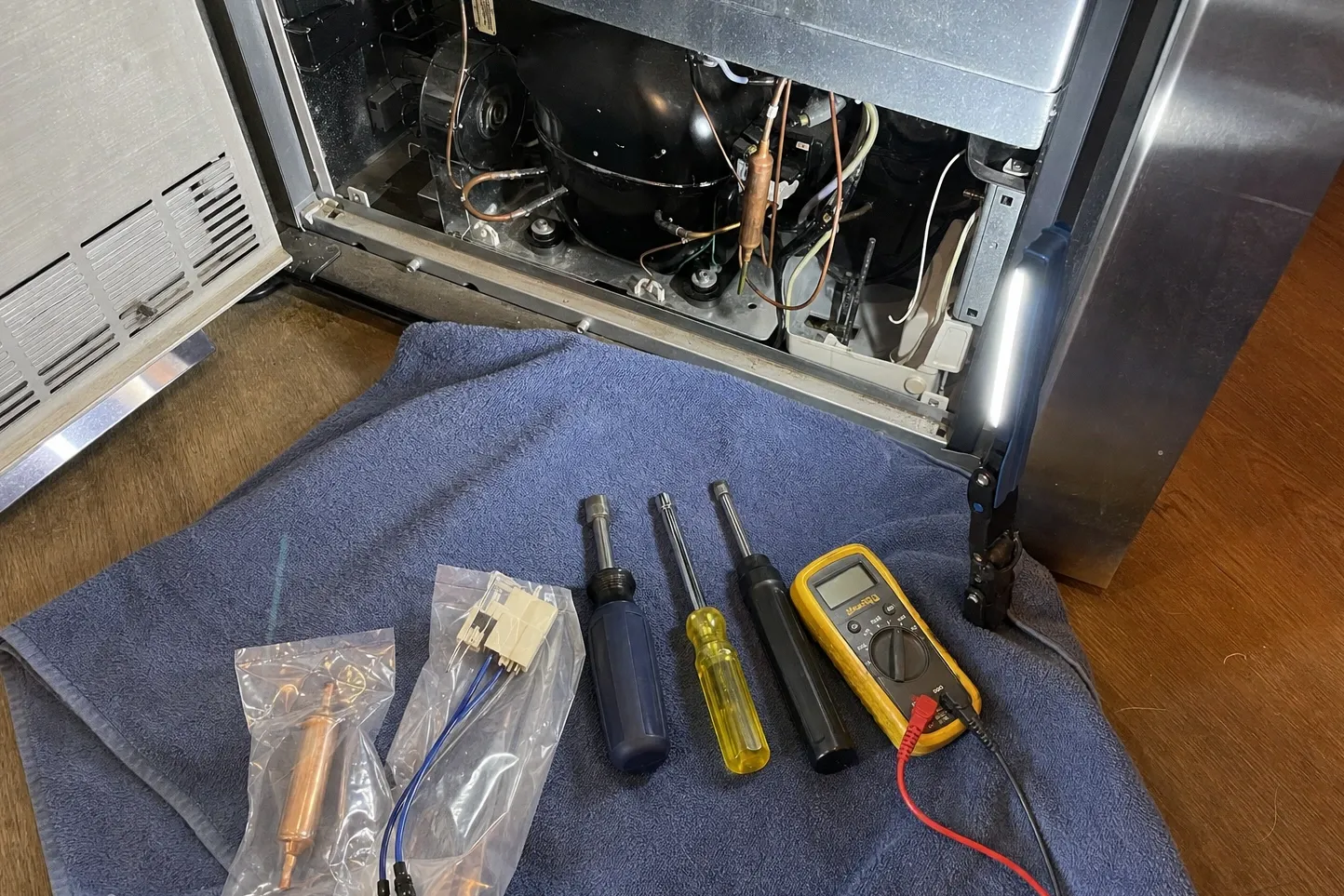
The electrical side. Volts arriving, continuity through the component, and whether the control board is calling for anything. This distinguishes a dead part from a supply that never reached it — a distinction worth a great deal of money.
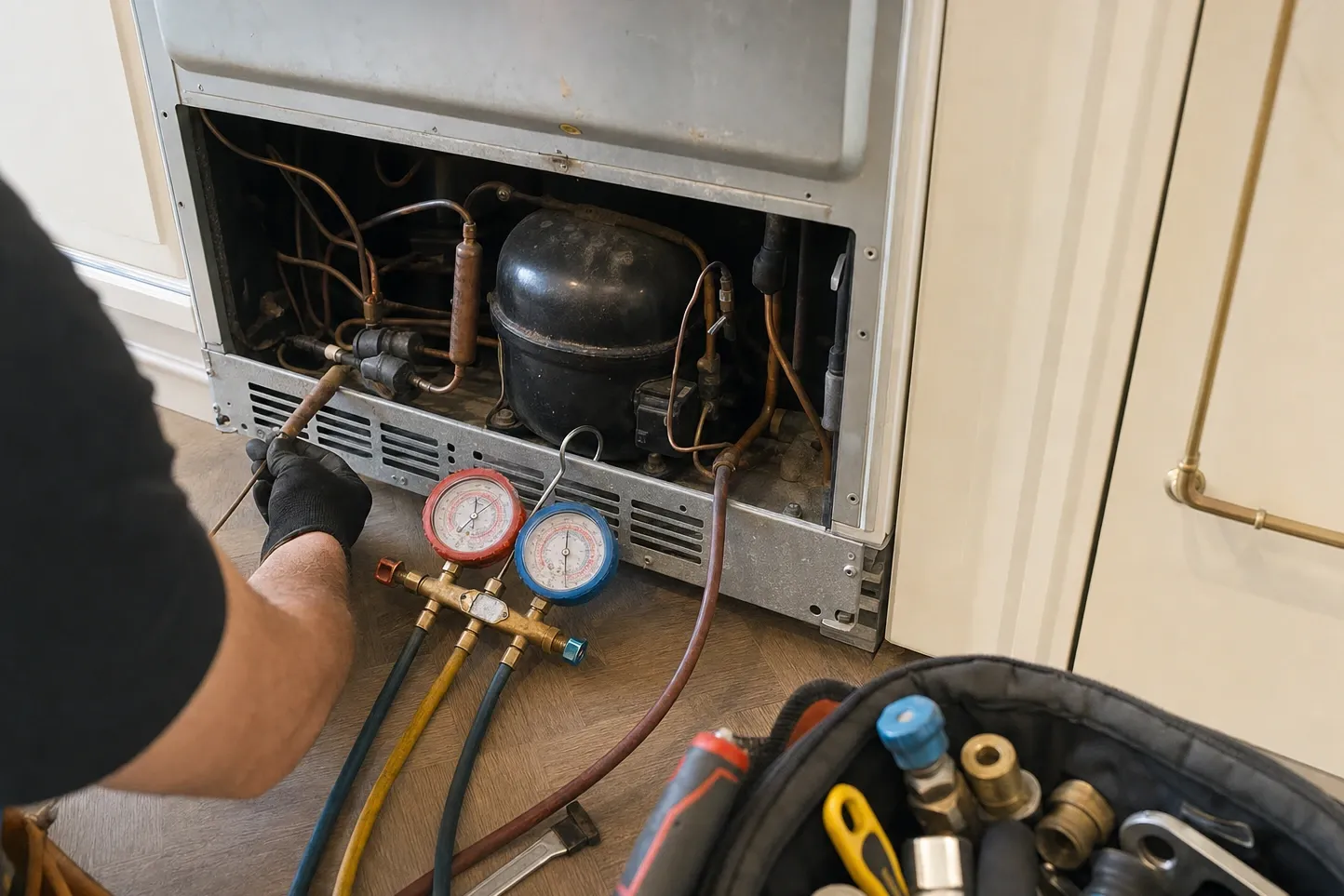
Pressures under load, last. Manifold gauges go on with the unit running, not at rest, and the readings say whether the refrigerant is moving through the whole loop, whether the charge is correct, and whether the compressor is pumping to specification. This is the only measurement that speaks for the sealed circuit, and it comes last because everything above it is cheaper to check.
What happens at the end of it
The visit finishes with something in writing rather than a verdict at the door: what was measured, what those numbers accuse, and a single price with the labour already inside it. Nothing is fitted on suspicion, and nothing is opened further until that figure has been approved.
The $89 service call is what puts somebody in front of the cabinet with instruments for all of the above, and it is credited back against the repair once you approve it. If the part is on the van, the work usually happens there and then. If it has to be ordered against the serial number, you are told that before anything is committed. And if the honest answer is that the cabinet is not worth the repair, that gets said too.
Then comes the part that requires nothing from anybody: time. A cabinet that has been opened, emptied of cold or had its charge disturbed needs a full day to come back down, and the ice maker is slower still. Judge it the following afternoon with a thermometer in a glass, not the same evening with a hand on a shelf. If the number is not where it should be by then, Sub-Zero Appliance Repair Los Angeles will come back to it on (310) 496-7399.
Follow-ups
- What do I need to have ready before the technician arrives?
- Clear floor in front of the cabinet, and somewhere for a drawer or two of food to sit. Access details matter more than paperwork: gate codes, parking, stairs and who opens the door. Model and serial help if the plate is in sight, and nothing is delayed if it is not.
- Why take a temperature reading when the panel already shows one?
- Because they are different numbers. Sub-Zero states that the figure on the control display is the unit setpoint, not the temperature inside the cabinet. On a healthy machine the two agree, and on a faulty one they part company, which is precisely when it matters.
- Will I be told the price before anything is taken apart?
- Yes. The diagnosis finishes with a finding in writing, the component it accuses, and a single figure that already has the labour inside it, and nothing is fitted before you approve it. Sub-Zero Appliance Repair Los Angeles quotes on (310) 496-7399 only after the readings, never over the phone.
- How long before I can tell whether the repair worked?
- Give it a day. Sub-Zero asks for twenty-four hours for a unit to reach its temperature after a change, and a cabinet that has been opened up is starting further back than that. Judge it the following afternoon with a thermometer rather than the same evening with a hand.