Refrigerator Repair
Sealed-System Repair on a Sub-Zero: What It Involves
Written by
Yuki Tanabe
Refrigeration technician — controls and sensors · 18 years in the trade
Tests a sensor against an independent reading rather than trusting the display it feeds. Drift is quiet, cheap to correct, and routinely mistaken for a dying compressor.
Every other fault on a built-in refrigerator announces itself somewhere you can look. A door seal is visible. A condenser is behind a grille you can take off with a screwdriver. A fan makes a noise. The sealed system does none of that: it is a welded loop of copper, a compressor and a measured charge of refrigerant, and from outside the cabinet it is completely silent about its own condition.
That is why the conversation about it goes wrong so often. It is the most expensive thing on the machine and the hardest to confirm, which makes it the easiest thing in the world to blame down a telephone.
The three cheaper faults that imitate it
Before anything gets attached to the circuit, the imitators get eliminated, because all three produce the same complaint — “it is not getting cold” — and all three cost a fraction of the real thing.
A condenser that cannot reject heat. Sub-Zero’s own advice is to clean the condenser every six to twelve months, more often with pets in the house. A coated coil does not stop the machine; it removes its margin, so the cabinet holds through a mild week and gives up on the first hot one. There is a useful threshold in the manufacturer’s troubleshooting: if a refrigerator set to 38°F is sitting above 48°F, cleaning the condenser on its own is unlikely to bring it back. Below that, it often does.
A fan that has slowed rather than stopped. Evaporator and condenser fan motors fade. Nothing on the panel reports a fan turning at reduced speed, and the symptom — warm compartment, compressor running constantly — is the sealed-system symptom exactly.
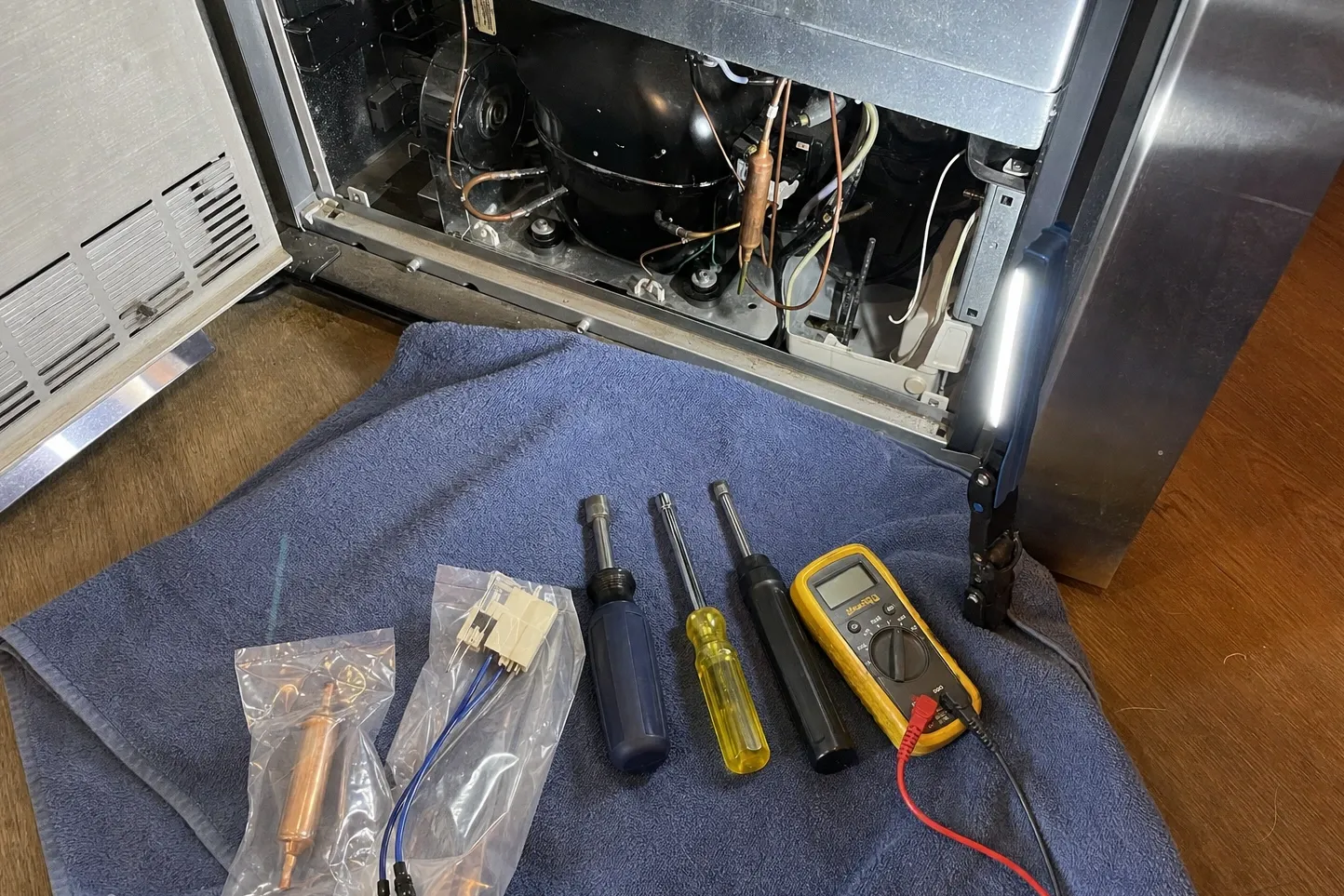
A sensor lying to the control. The panel shows the setpoint, not the cabinet. If a thermistor reads low, the board believes the compartment is colder than it is and stops asking for cooling. A probe on the shelf settles that in minutes and costs nothing to check.
None of these is a guess. Each one is a measurement, and the order they are taken in is what keeps the expensive answer honest.
What the diagnosis actually consists of
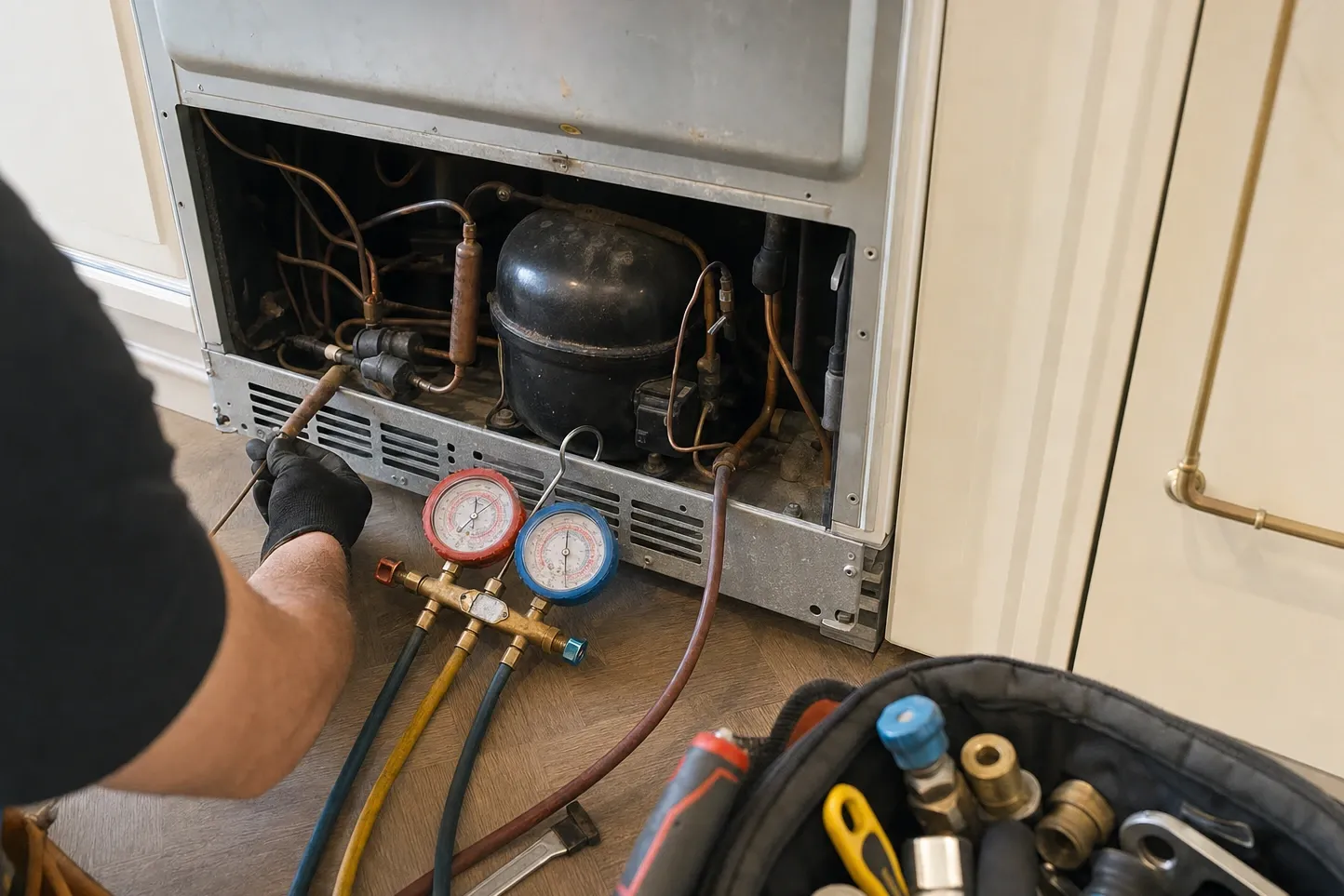
Manifold gauges go onto the service ports and the circuit is read while it is running, not at rest. Suction and discharge pressures together describe what the compressor is doing and whether the refrigerant is moving through the whole loop. Current draw at the compressor says whether it is working or merely humming. The temperature of the line leaving the compressor and the temperature at the evaporator, taken together, say whether the charge is correct, low, or restricted somewhere.
Three distinct faults live inside the phrase “sealed-system problem” and they do not cost the same:
- A leak. The charge has gone somewhere. It has to be found, not topped up — refrigerant does not get consumed, so a unit that needed gas last year and needs it again has a hole in it.
- A restriction. The loop is blocked, usually at the filter-drier or a capillary. The compressor is fine; the refrigerant is not circulating properly.
- An inefficient or failed compressor. It runs, it draws current, and it is no longer pumping to specification.
Telling them apart is the whole value of putting gauges on. Each one has a different repair and a different amount of work behind it.
Why no price is quoted before that
Everywhere else on this site, the band is printed before the visit. Sealed-system work is the one exception, and the reason is in the list above: a leak found at an accessible joint and a failed compressor on a cabinet that has to come out of joinery are the same category and nowhere near the same job. The band on the repair pages is the range the work falls in. Which end of it you are at is decided by the reading, not by the phone call.
What does not change is the front of the process: $89 puts somebody in front of the cabinet with instruments, and that $89 is credited back against an approved repair. One figure, agreed before anything is opened further.
What you can do, and where to stop
Take the grille off and look at the condenser. Clean it if it needs it — a vacuum and a soft brush, unit switched off first, and no chemical cleaner, which Sub-Zero specifically says is unnecessary. Put a thermometer on a shelf and find out what the cabinet is really holding rather than what it claims. Check that nothing is holding a door a few millimetres open.
Then stop. A sealed refrigeration circuit is under pressure, it contains refrigerant that is federally regulated, and opening one without a technician who holds EPA Section 608 is not a question of skill. There is nothing an owner can usefully test beyond the grille, and nothing worth risking a cabinet for.
If the readings you can take point past that line, the number is the next step.
Follow-ups
- How do I know it is the sealed system and not something cheaper?
- You largely cannot from outside, and that is the point of the visit. What you can do is rule things in: a cabinet warm in every compartment at once, running continuously, with a condenser that was cleaned inside the last six months, is the shape that puts the sealed system on the list.
- Is it worth repairing, or should the cabinet be replaced?
- On a built-in, almost always repairing. The sealed-system band on our repair pages is a fraction of what a comparable built-in replacement costs before any cabinetry work, and these cabinets were designed to be serviced in place rather than swapped out.
- Can any appliance technician do this work?
- Opening a sealed refrigeration circuit requires EPA Section 608 certification, which is a federal requirement rather than a manufacturer preference. It is issued to a technician, not to a company, and the ones Sub-Zero Appliance Repair Los Angeles sends on this work hold it. Ask anybody quoting you for sealed-system work the same question before they start.
- How long before it is cold again afterwards?
- Allow a full day. Sub-Zero's own guidance is to give a unit 24 hours to reach a new temperature setting, and a cabinet that has been open, evacuated and recharged is starting from further back than that. Judge it the following afternoon, not the same evening.