Ice Maker Repair
Los Angeles Water, Filters and Scale Inside a Sub-Zero
Written by
Yuki Tanabe
Refrigeration technician — controls and sensors · 18 years in the trade
Tests a sensor against an independent reading rather than trusting the display it feeds. Drift is quiet, cheap to correct, and routinely mistaken for a dying compressor.
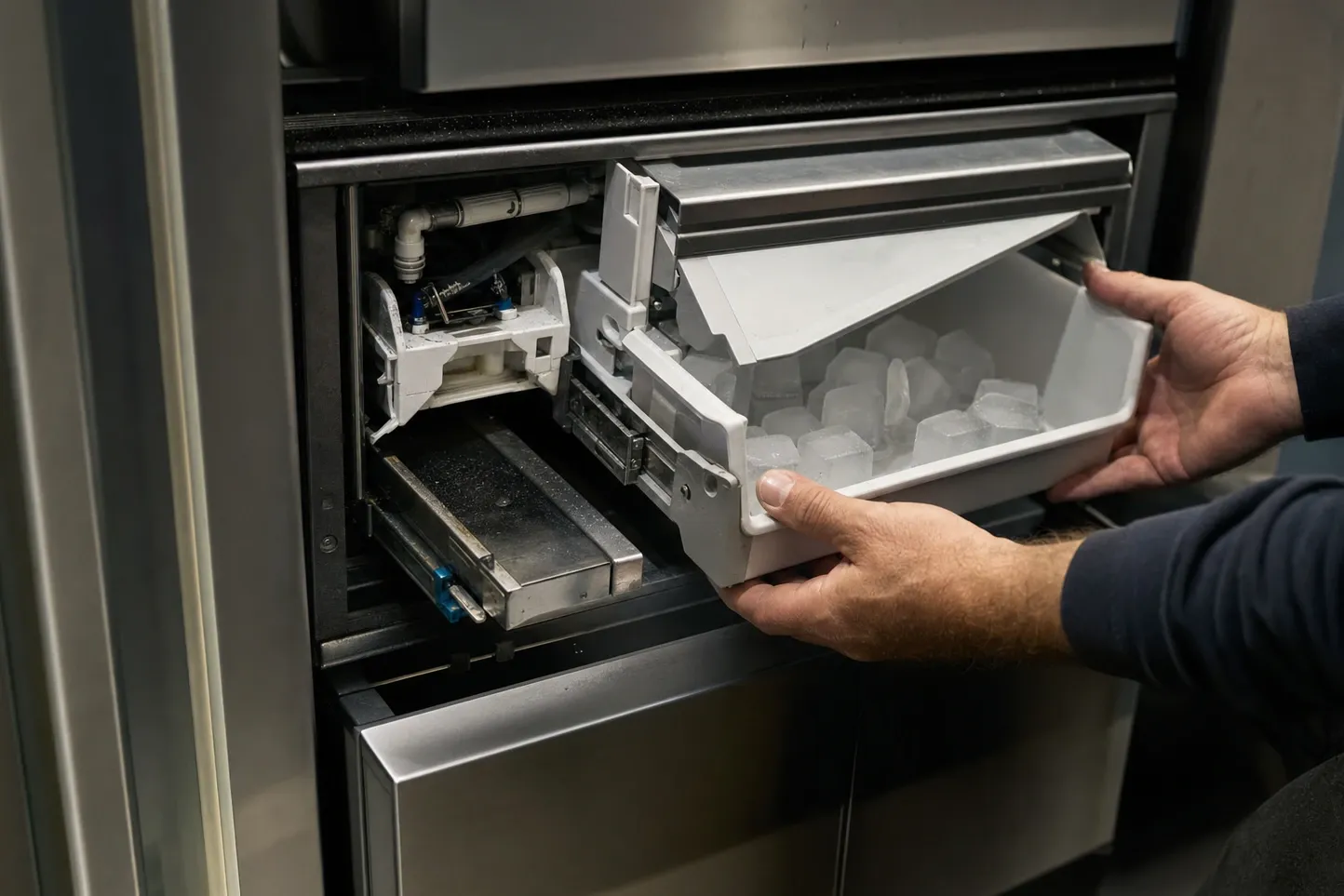
Nothing in a built-in refrigerator measures the water arriving at it. The ice maker takes what the house sends, freezes it, and hands back a physical record of what was dissolved in it — which is why the water in this city becomes an appliance conversation at all. The machine has no opinion about minerals. It just concentrates them somewhere you can see.
That is worth saying at the outset, because the complaints that bring people to the phone here fall into two very different groups. One group is the supply showing itself, and no repair fixes it. The other group is a genuine fault that happens to look similar. The whole of this page is about telling them apart.
What the flecks actually are
The most common version is pale specks in a cube, most obvious as it melts. Sub-Zero’s own explanation is straightforward: calcium in the water causes white flecks in ice, and the concentration increases through freezing and thawing. Ice left standing in a bin also loses moisture to the freezer’s dry air, and what was dissolved through the whole cube gathers at the surface as a chalky residue.
So an untouched bin at the back of a second freezer will always look worse than ice used daily, and a bin emptied and refilled will look better without anything having been repaired. If you want to settle the question in an afternoon, the manufacturer’s suggestion is to make a batch of ice in a tray using water from a different tap and compare the two. Flecks in both point squarely at the supply.
There is one variation that is not cosmetic. Blue or green ice, Sub-Zero says, comes from copper corrosion in the water line supplying the refrigerator. That is a plumbing fault rather than an appliance fault, it does not improve on its own, and the sensible response is to stop using the ice and get the line looked at by a plumber.
What a filter is for, and what it is not
A cartridge in a built-in does a narrow job well: it improves taste and odour and it catches sediment. It is not a softener. It does not remove the dissolved minerals that produce the flecks, and nothing about fitting a new one will make a cube come out clear.
It is also not a pressure device, which matters more than it sounds. A cartridge that has been in place far too long restricts flow, and a restricted fill is the single most common way a water problem turns into an ice problem.
Two details of the change itself get skipped constantly, and both come from the manufacturer rather than from habit. After a new cartridge goes in, the first full bucket of ice the unit makes is thrown away — that production run is what clears the air the change introduced and flushes the system, and on a unit with a dispenser the first several glasses of water go the same way. Judge the new filter before that and you are judging the worst water it will ever deliver. And on the twist-in style, the filter life monitor is reset by pressing and holding the reset button beside the cartridge for five seconds, which is the step that stops an indicator nagging about a cartridge already sitting in place.
One caution about the monitor itself: it counts elapsed time, not what has passed through the cartridge. A house that is empty for the summer and a house of six will get the same reminder. Treat it as a diary entry and let taste and flow carry the real vote.
The fault people mistake for scale
Here is where the money is. A cube that comes out small, hollow or part-formed looks like a mineral problem to almost everyone, and Sub-Zero reads it as something else entirely: low water pressure at the unit. The mould fills short, the cube forms around the gap, and the complaint arrives as “the ice has gone strange” rather than as a plumbing question.
That is a measurement, and it is the reason a visit starts on the water side rather than at the module. Is the shut-off fully open. Is the cartridge current. Is the fill valve energising and for how long. What is actually arriving at the inlet. A module replaced on a supply that cannot fill it is a part bought for nothing, and it is a fairly common way to spend money on this fault.
If you are considering fitting something upstream to improve matters, have a plumber confirm the supply first. Anything of that kind sits on the household line rather than inside the appliance, and it has to leave the supply the cabinet was designed around intact. Cloudy ice is cosmetic; undersized ice is a fault, and swapping one for the other is not an improvement.
What upkeep in this city actually looks like
It is a short list, and none of it needs a tool.
Change the cartridge when the indicator or the glass in front of you says so, and use the maker’s own filters. Discard the first bucket of ice afterwards. Empty a bin that has stood unused rather than scooping through the layer at the top. Keep the supply shut-off fully open, and if a plumber has been working anywhere in the house, check that it still is. Give any change a full day before you judge it, because Sub-Zero asks for twenty-four hours before ice production is assessed at all.
Do that and this city’s water gives a built-in nothing it cannot handle. When the cubes stay thin after a fresh cartridge, or the module has stopped altogether, what is left is the part of the path no kitchen inspection reaches: the inlet valve, the fill tube, and the pressure arriving at them. That is what the $89 service call buys: somebody in front of the cabinet with instruments, working the water path in order. Sub-Zero Appliance Repair Los Angeles takes those on (310) 496-7399, and the $89 is credited once a repair is approved.
Follow-ups
- Are the white flecks in my ice a sign the machine is failing?
- No. Sub-Zero attributes white flecks to calcium in the water, concentrated as a cube freezes and again as it sits in the bin. It is a report on the supply rather than on the appliance, and the maker suggests freezing water from another tap to confirm it.
- How often should the cartridge be changed?
- By the indicator on the interior control and the manual for your own model, rather than by a rule you read somewhere. The monitor counts elapsed time, not what has passed through the filter, so taste and flow are the more honest prompt between resets.
- Can hard water actually stop an ice maker?
- Rarely on its own. What stops a module is usually low pressure at the fill valve, and the maker reads a thin or hollow cube as a pressure problem rather than a mineral one. Sub-Zero Appliance Repair Los Angeles measures that rather than guessing at it.
- My ice is blue or green rather than cloudy. Is that the same thing?
- It is not, and it is worth acting on. Sub-Zero puts blue or green ice down to copper corrosion in the water line feeding the unit, which is a plumbing matter rather than an appliance one. Stop using the ice and have the supply line looked at.