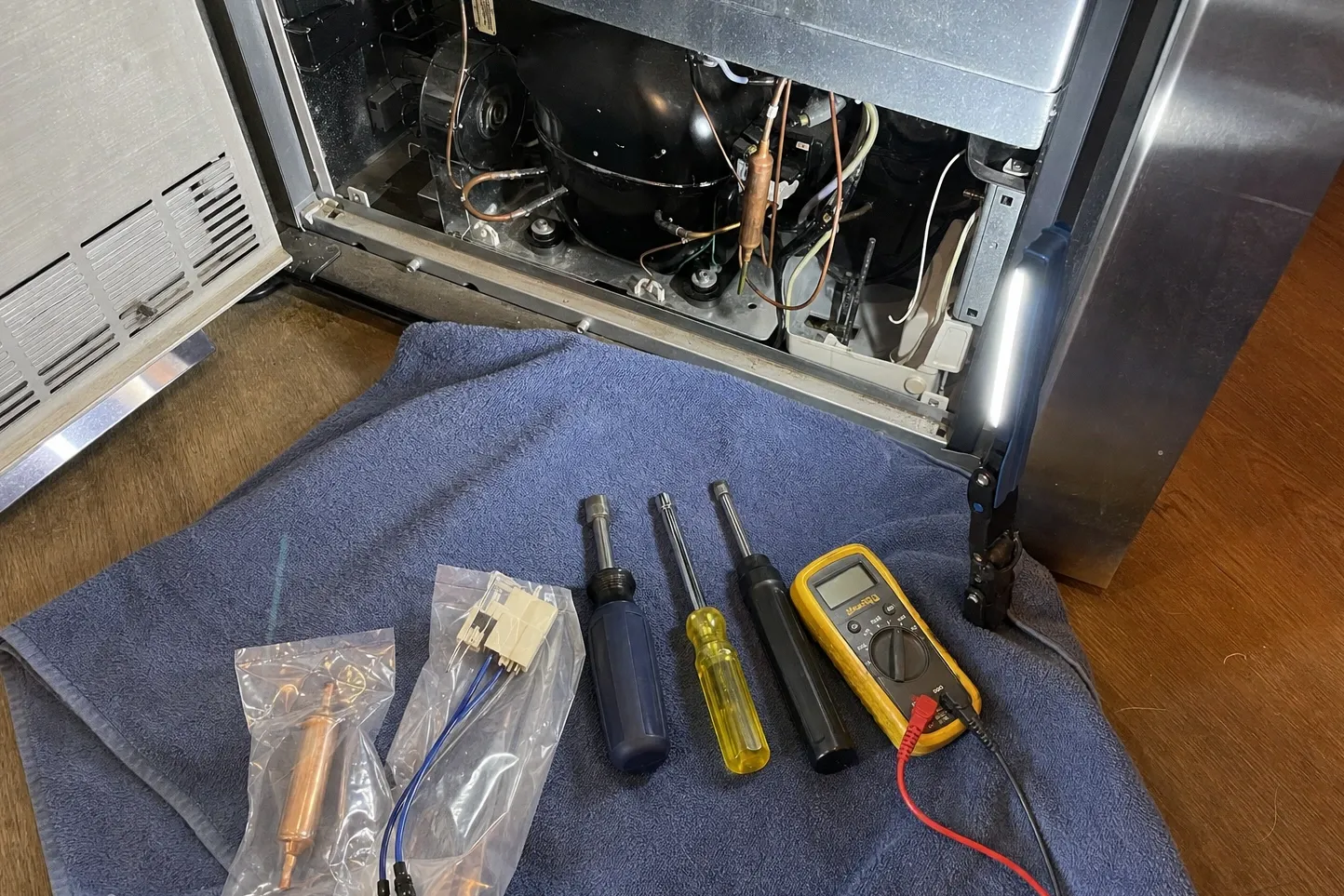
Refrigerator Repair
After the Palisades Fire: What Ash, Smoke and Two Weeks Without Power Actually Do to a Built-In Sub-Zero
Written by
Yuki Tanabe
Refrigeration technician — controls and sensors · 18 years in the trade
Tests a sensor against an independent reading rather than trusting the display it feeds. Drift is quiet, cheap to correct, and routinely mistaken for a dying compressor.
What people here assume is wrong with it
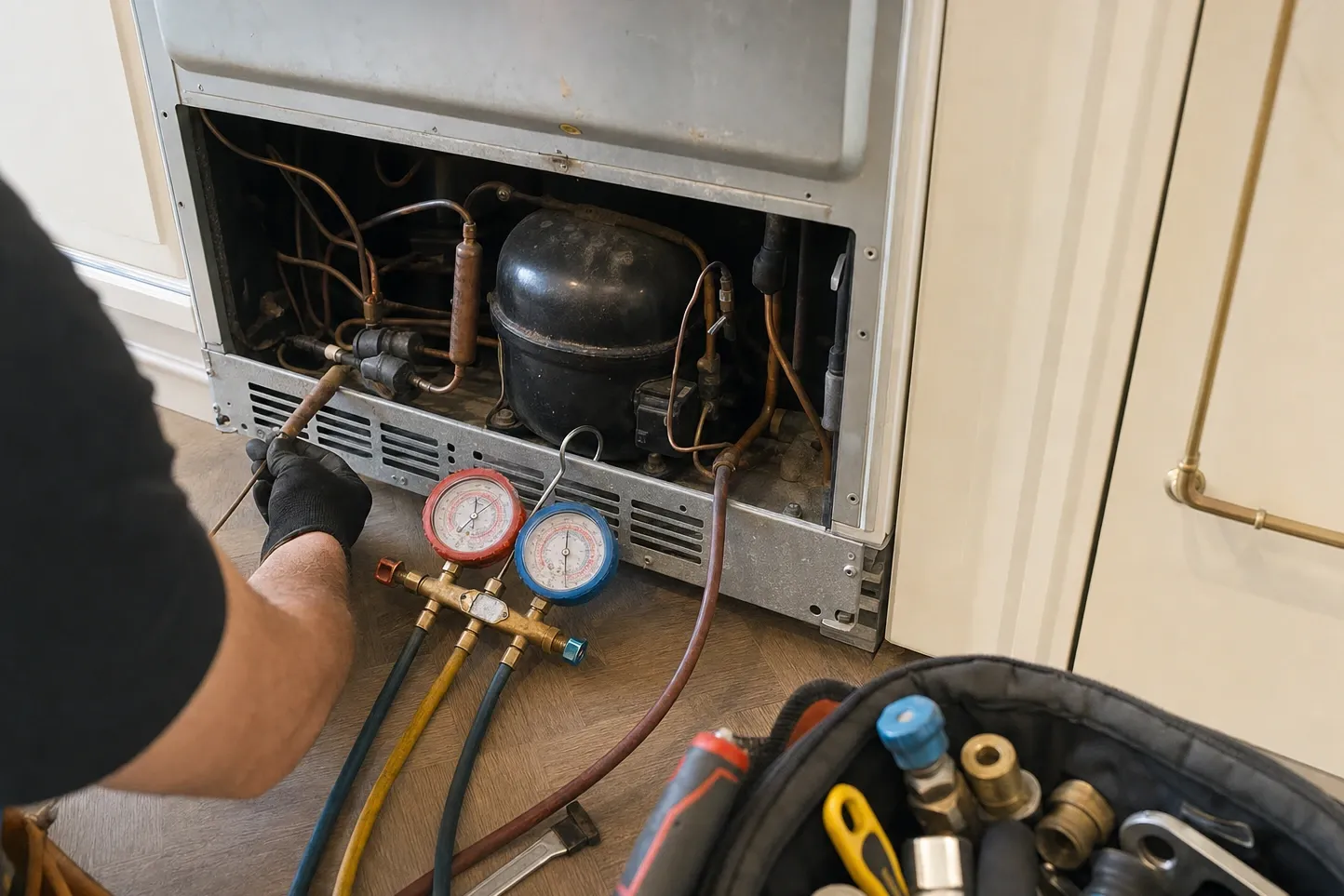
Nearly every post-fire call opens the same way: the compressor must be finished. It rarely is. On the built-ins we open west of the 405, the fault is a condenser coil matted with fine ash, a fan motor worn down dragging that load for a year, or a control board that quietly failed during a restoration cycle.
The Palisades Fire began on 7 January 2025, burned 23,448 acres and destroyed 6,837 structures. Houses that never saw flame still stood under the plume for days. Pacific Palisades sits inside that footprint, and the Los Angeles Fire Department’s own fire-zone history names portions of Bel Air Estates, Brentwood and Pacific Palisades among the parts of the city inside the Very High Fire Hazard Severity Zone. When CAL FIRE’s recommended zone maps were released on 24 March 2025, Very High acreage citywide rose by roughly seven percent while the Palisades saw virtually no change — it was already in.
Hancock Park is outside all of that. No brush, no zone, and also no ocean breeze to help in a heat wave. A column shoehorned into a butler’s pantry off a nineteen-twenties kitchen has the least generous airflow of anything on our route, and drifting smoke still had to be pulled through it.
What none of this produces is a failure the week of the fire. It produces one twelve or eighteen months later, which is why January almost never comes up until we ask.
What is actually happening
There were two separate insults, and they run on two different clocks.
The first is particulate. A built-in draws room air in at the toe grille, over the condenser, and back out into the kitchen. Wildfire ash is much finer than household dust, and it does not sit politely on the coil face — it works down between the fins, mats to the oily film every condenser carries, and coats the fan blade unevenly. A coil that cannot shed heat raises head pressure; higher head pressure lengthens run time; and a sealed system that never gets a rest period is working a duty cycle nobody designed it for. The same air stream passes the air purification cartridge. Smoke residue that lodges there, in the cartridge and in the gasket, is the reason an owner can scrub every shelf and every drawer and still smell the fire.
The second is the power. An outage measured in days, followed by a restoration that arrives in stutters, hard-starts the compressor repeatedly against pressure it would normally never see, and exposes the dual-refrigeration control boards to switching events with no load behind them. Boards that survive that often survive imperfectly. A sensor input drifts a couple of degrees, a defrost cycle stops terminating cleanly, and the owner meets the consequence a season later as a sheet of ice across the floor of the cabinet.
There is a third category people ask about that is not repair at all. A house rebuilt inside the burn footprint takes new units into new cabinetry, and that is an installation — framing, clearance, levelling, panel fit — booked and priced as its own job.
What gets examined, and in which order
We work it in a fixed order, because the cheap answers live at the top of the list and the expensive one lives at the bottom.
First, two real temperatures, taken in the cabinet with our own instrument rather than read off the display. A fresh-food side drifting into the fifties while the freezer column still holds zero is not a compressor story at all — in a dual-refrigeration cabinet those are two systems, and one of them is fine.
Second, the grille comes off and we look at the coil face, the fin pack behind it, and the blade. Ash reads differently from dust: grey, fine, packed deep rather than fluffed on the surface.
Third, run time and current draw on the compressor circuit. A machine that has not stopped all afternoon in a house over ninety degrees is telling us about heat rejection, not about the compressor itself.
Fourth, the condenser fan — bearings, blade balance, and whether it is actually commanded on when it should be.
Fifth, the door. A seal that pulls back against you seconds after closing is a hinge and gasket question, and gaskets that lived through a smoke event stiffen early.
Sixth, the drain and the defrost circuit: heater resistance, sensor reading, termination.
The board is last, always. It is the part most often blamed and least often at fault, and it is expensive enough that guessing at it is not acceptable.
The fix that holds
A coil that took wildfire ash does not come clean with a vacuum pass at the grille. It needs the fin pack combed and cleared front to back, the blade cleaned so it is balanced again, and the cartridge and gasket dealt with at the same visit — otherwise the odour complaint returns and the run time never really drops.
Where parts are needed, this is what the work bands look like. Door gasket or seal replacement runs $260 to $680. An evaporator or condenser fan motor is $300 to $720. Defrost heater, thermostat or sensor work is $280 to $610. Ice maker, water valve or supply line work is $260 to $840. An electronic control board is $440 to $980. Compressor or sealed-system repair is the genuinely expensive one at $1,400 to $2,960, and it is the diagnosis we work hardest to rule out before we name it, precisely because so many post-fire units get condemned on a symptom that a clean coil would have fixed.
Where to stop and call
Stop when cleaning what you can reach has not changed the running temperature after a full day. Stop when the frost pattern in the freezer column is uneven, when water is standing under the crisper drawers, or when the fresh-food side is warm while the freezer is untouched — that split points at airflow, defrost or a control fault, and none of those improve on their own. Stop immediately if you can smell anything hot or electrical near the grille.
Diagnosis on a built-in starts at $89, and what that buys is a part number instead of an opinion. (310) 496-7399 if you would rather describe it than type it. Tell us if the address sat in the burn area or lost power in January 2025 — it changes what we load on the van.
Follow-ups
- Is my Sub-Zero worth repairing after it sat through the Palisades Fire without power?
- Usually yes, if the cabinet and cabinetry are sound. Ash loading, a tired condenser fan and a drifting board are all serviceable, and the fresh-food side warming while the freezer holds is one of the more repairable patterns we see. The decision changes only if the sealed system itself is compromised, since that band runs $1,400 to $2,960. We would rather establish which of those two situations you are in before anyone talks about replacement.
- Why does my refrigerator still smell of smoke after I cleaned every shelf?
- Because the odour is not in the food compartment. It is in the air purification cartridge, in the door gasket and in the porous surfaces air passes on its way through the cabinet. Wiping shelves never reaches any of those. Replacing the cartridge and dealing with the gasket, along with clearing the condenser where soot has collected, is what actually removes it, and gasket work falls in the $260 to $680 band.
- We are rebuilding in Pacific Palisades. Is setting the new units in a repair call?
- No, that is an installation and it is booked differently. New cabinetry means checking the opening, the clearances the condenser needs, levelling, panel fit and the water line before anything is slid in. It is a longer visit with different questions, and getting the clearance right at that stage is what keeps the unit off our repair list in Brentwood and Bel-Air five summers from now.